
Deputy Mayoral Candidate Rob Uhrig (acclaimed)
Responds to IMAGE MEAFORD’S questionnaire:
Q1: Meaford is experiencing dynamic growth. How do you see ratepayers’ involvement in that growth? What role do you see the community playing in establishing the common direction and longer-term priorities?
I agree that Meaford is growing and believe it is a good thing. I also believe that the public has a very important role in ensuring that it is smart growth. While there are already guardrails in place with mandated public information and input meetings, I believe we can do more. As an example, Council allocated $200k in the 2026 budget for a 2027 Harbour and Downtown Urban Meaford Master Plan which will seek input from the public, businesses and residents. I am also pushing for a public Visioning Exercise that will include all the municipality. This, in concert with the current Business Retention and Expansion project, will contribute to updating our now expired Economic Development Strategic Plan.
Q2: Would you support the development of an active community-based Advisory Committee for planning and development?
I would consider supporting such an initiative depending on how it fits into the overall Advisory Committees that are addressed in Question 3. Such a body may not make sense if there is significant overlap with whatever advisory committees are struck in the new term. Overall, I agree there needs to be input in planning and development. What direction that takes will need to be determined.
Q3: Currently, Meaford Council has just two Advisory Committees: Heritage and Accessibility. Prior to this current Council, there were seven advisory committees. Given that advisory committees facilitate public input into important matters, would you reinstate other advisory committees? And how would you ensure they are used effectively in the next term of Council?
The Accessibility advisory committee is legislated by the province. The Heritage advisory committee was retained to ensure the protection of our important heritage district. There will be additional Advisory Committees in the next term of Council. What they will look like will depend on the desire of the new Council, particularly in conjunction with whatever strategic priorities are introduced. The four pillars that formed the past Advisory Committees were: Ensuring Sustainability, Growing Our Economy, Investing In Infrastructure, and Strengthening Our Community. I believe future Committees will still have to somehow encompass these foundational priorities.
There has been much discussion regarding not only the composition of the past committees, but whether they were effective. I have long been concerned that these bodies only meeting six times per year does not provide enough time for adequate input. Having said that, additional meetings require more staff time which can come with a higher cost.
Finally, these bodies are dependent on the dedication of the participants and some of the advisory committee meetings had to be cancelled due to a lack of quorum.
Q4: What is the role of Council and the Municipality in supporting the development of downtown Meaford? In rural areas? Please provide examples.
Council’s provincially legislated role is to develop, approve and maintain an Official Plan, establish planning policies, pass binding zoning by-laws, and make statutory decisions based on the Planning Act and Municipal Act.
Where there is flexibility is in creating and administering incentives like Community Improvement Plans, which Meaford does. This initiative offers financial incentives, grants, loans and tax rebates to encourage heritage conservation and downtown beautification.
It is important to note that, through the Strong Mayor Legislation, it is now the Mayor that prepares and provides the annual budget for Council review and final approval to fund local projects and services.
It is Council’s responsibility to work with the CAO to make sure the Planning and Building Departments properly serve both the development community and the public. This has long been a pain point in Meaford, and the last term of Council has gone to great lengths to, first, hire a new CAO with a positive vision for support and communication; and second, to overhaul these departments. This transition has been happening over the last year, and I believe we are much better positioned to foster growth moving forward.
Finally, we cannot discuss roles without including Grey County. As Meaford’s upper-tier body, our local planning documents and zoning by-laws must align with the broader policies set at the county level. They set regional growth frameworks and review major development applications. This is why it is important that Meaford have strong representation at County Council via the Mayor and Deputy Mayor.
Q5: What role does Meaford’s “Official Plan” have in guiding development?
The OP legally guides all land use decisions, growth management, and development strategies throughout the community. It establishes clear policies and objectives detailing where housing, agricultural, commercial, and industrial areas should be located, as well as the necessary infrastructure to support them. It is a long-range policy that ensures growth respects Meaford’s unique heritage features and rural lifestyle.
Many people think we are autonomous so it is again important to mention that Grey County has an overarching OP and Meaford’s local planning documents and zoning by-laws must align with these policies. Additionally, Grey County approves Meaford OP amendments.
Q6: If a development project does not appear to meet Official Plan requirements (like the SkyDev proposal), what should Council do to ensure the project is in the best interest of Meaford and its citizens?
As a creature of the province, Meaford is bound by the legal framework and overall policy direction set by Ontario. Staff is bound to follow both the OP and the Planning Act which can lead to unjust frustrations for the development community. This is most evident by the number of times the Municipality has had to deal with developer challenges through the Ontario Land Tribunal. The OLT has the power to overturn local Council decisions regarding OP and zoning disputes. Depending on the dispute, Council can defend Staff and public recommendations, such as is currently happening with the recent SkyDev proposal.
Q7: Should Council members or municipal staff meet with developers prior to a development application being submitted? What is your understanding of them role in such meetings? Can you give us an example of what you would do in that position?
Municipal Staff should definitely meet with developers before an application is submitted through a formal pre-consultation process that manages expectations and defines the realities of local OP and zoning requirements.
Council members should not be involved at this stage to avoid any potential conflict of interest. Again, Council is elected to set policy. Staff is hired to execute those policies.
Q8: There are many issues that need to be addressed in the coming four-year term, including the TCE pumped energy project, affordable housing, job creation, the downtown heritage district, business development, climate change, tourism, and a host of infrastructure needs supporting agriculture, bridges, roads, water and sewer and urban green spaces. What, in your opinion, are the most urgent issues to address?
The reality is it is all the above.
While the TCE project may be one of the largest this Council and community will ever have to deal with, Council does not have a veto vote and must rely on the IAAC impact studies to provide the necessary information to determine how it wishes to proceed with the “conditional” willing host motion.
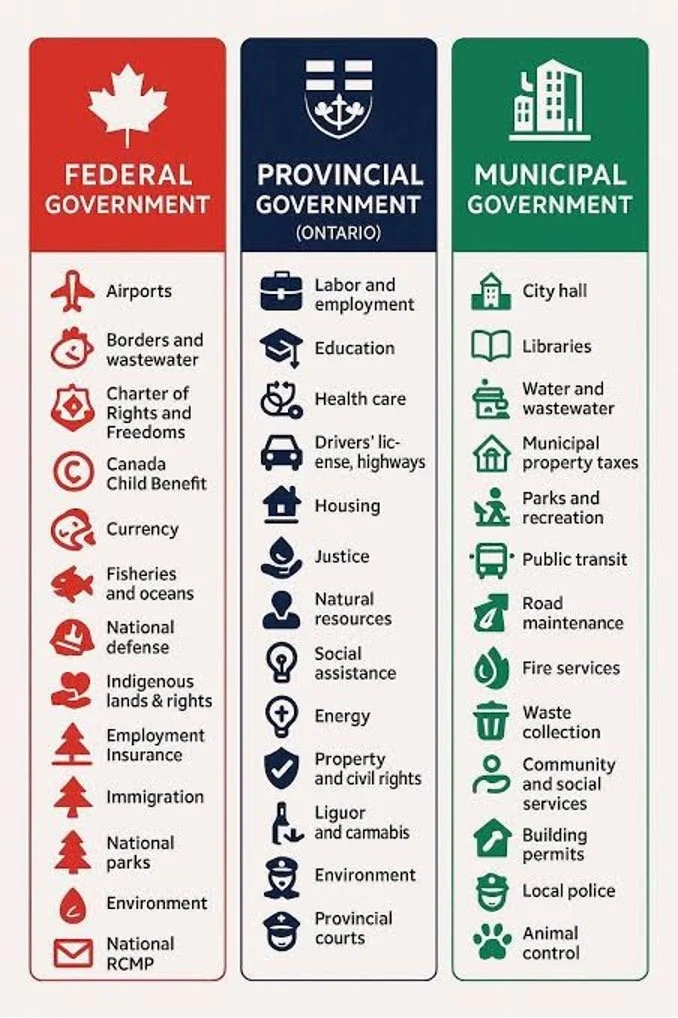
My primary priorities are responsible growth, infrastructure, and economic development which again touch on the rest of the items in the question. It is important to know exactly what the varying levels of government in Canada are responsible for which is illustrated in the following chart:
Q9: The TCE Pumped Storage Proposal will be decided by the federal government. What is your position on the project, and what role do you think the Meaford Council has as the project moves through approvals?
The TCE project will actually be decided by much more than just the federal government. Once the IAAC approvals process has been completed, the province, IESO, SON, DND and TCE itself will all have a part in the eventual decision. Meaford can only control whether it has a seat the negotiating table for a Community Benefits Agreement should the project proceed. Council currently only spends approximately 5% of its time on this topic as actionable legislative voting items. In my opinion, Council needs to focus on the other 95% of issues it can directly influence.
My opinion is, Meaford needs to position itself to benefit if the project is approved. The recently negotiated Pre-Development Agreement is an example of how our community can benefit from proximity to a major energy project it cannot control. This is standard procedure as evidenced in communities like Port Elgin, Kincardine and Port Hope. If the project proceeds, our community will be directly impacted and we need to ensure we are in a position to negotiate a Community Benefits Agreement both during construction, and over the life of the project.
Q10: As a member of Council, how will you work with local and county/regional partners and Meaford's CAO and staff to move the Municipality forward on the issues listed in Q8? Can you provide any examples?
As the acclaimed Deputy Mayor, I will have a seat the County table and will advocate for Meaford in all facets.
At our own Council table, I will continue to protect our community and ensure development fits Meaford’s unique culture. Examples:
I supported the Committee of Adjustment’s position to refuse SkyDev’s recent variance requests
I will not support the proposed oversized Avrance proposed development on Trowbridge Street East
I support the consideration of a Tiny Homes community in urban Meaford to provide affordable housing
I supported the decision to purchase 25 acres of serviceable commercial/industrial land along Highway 26 to support business growth in our community.
With more than 400 km of road, 80 bridges. and 25 km of sidewalks that must be paved, plowed, maintained and/or replaced, I am committed to ensuring that our community’s network is properly serviced.
Our rural sector is still one of our most important attributes. I support protecting our farms, orchards, rivers, trails, parks, conservation areas, and rural small halls that define our character.
I was a member of the Economic Development Advisory Committee before being on Council and was the Chair of the Growing Our Economy Advisory Committee in my first term. I will continue to champion business development as we need to foster the next generation of entrepreneurs that will shape the future of Meaford.